

Something remarkable happened on December 15, 2025, and millions of Americans had no idea it applied to them.
On that date, Bill C-3, an Act to Amend the Citizenship Act, came into force in Canada. Quietly, without fanfare, it changed everything for anyone with Canadian roots. The new law removed the so-called “first-generation limit” on citizenship by descent, thereby effectively granting Canadian citizenship to potentially millions of people who had never set foot in the country.
You don’t need to apply to become a Canadian citizen under this law. For many people born before December 15, 2025, you already are one. What you do need to do is prove it.
This guide explains why Americans are pursuing Canadian citizenship in record numbers, what the new law actually says, how to trace your ancestry, and how to apply for a Canadian citizenship certificate — the document that officially confirms your status.
On This Page
Why Are So Many Americans Looking to Canada Right Now?
The surge is the convergence of two things: a major legal change that opened the door and growing political uncertainty in the United States, which motivated people to walk through it.
In the first six weeks after Bill C-3 became law, Canada received more than 12,000 proof-of-citizenship applications. In January 2026 alone, U.S. applications outnumbered those from all other top source countries combined — including the UK, France, China, Australia, and Germany. The reasons range from wanting a second passport to concerns about civil liberties. LGBTQ Americans have been applying in significant numbers. Many simply want options.
For many, the discovery is personal. Families across New England, the Midwest, and the South are tracing their roots to nearly one million French Canadians who emigrated to U.S. factory towns between 1840 and 1930. For their descendants, Canadian citizenship was always there; the law just hadn’t recognized it.
What Changed: Bill C-3 and the End of the First-Generation Limit
To understand why this moment is so significant, it helps to understand what the old rules said — and why they were changed.
The Old Rule
Under the previous law, Canadian citizenship by descent could only be passed down for one generation born outside Canada. This meant:
- A Canadian citizen could pass citizenship to a child born abroad
- That child could not pass citizenship to their child born abroad
This cutoff — known as the “first-generation limit” — was introduced in 2009 as part of broader citizenship reforms. For the descendants of Canadians living abroad, it created what many felt was an arbitrary and unfair barrier. In December 2023, the Ontario Superior Court of Justice agreed, ruling that the first-generation limit was unconstitutional.
What Bill C-3 Does
Bill C-3 came into force on December 15, 2025, and retroactively removes that limit for anyone born before that date.
Here is what that means in practical terms:
If you were born before December 15, 2025, there is no generational limit on how far back your Canadian ancestry can go. If your grandparent, great-grandparent, or even a more distant ancestor was a Canadian citizen, and you can prove an unbroken chain of descent to that person, you may already be a Canadian citizen — and you have been since birth.
If you were born on or after December 15, 2025, different rules apply. A Canadian parent who was also born outside Canada must demonstrate a “substantial connection” to Canada by showing at least 1,095 days (three years) of physical presence in Canada before the child’s birth.
Important: Under Bill C-3, citizenship is automatic for those who qualify — but you still need to prove it. The way to do that is to apply for a Canadian citizenship certificate.
Step 1: Determine If You Qualify
You may qualify if:
- A parent, grandparent, or earlier ancestor was born in Canada or became a naturalized Canadian citizen
- You can document your family lineage, connecting you to that ancestor
If you can answer yes to both of those questions, and you were born before December 15, 2025, there is a strong chance you are eligible. The chain of descent must be traceable and documentable — but it can go back as many generations as needed.
Not sure? Canadim offers a free citizenship assessment that can help you evaluate your eligibility.
Step 2: Gather Your Ancestry Documents
This is where many applicants get stuck — and where preparation makes all the difference. IRCC requires documentary proof of every person in the generational chain connecting you to your Canadian ancestor. The more generations involved, the more documents you will need.
Here is what you are likely to need and where to find them.
A Note on Archive Delays
-
Start Gathering Documents Early
The BAnQ in Montreal went from 32 archive requests in January 2025 to over 1,000 in January 2026 — mostly from Americans. Nova Scotia, New Brunswick, Ontario, and BC have all reported similar surges. Expect delays and use a trackable courier when submitting.
Step 3: Prepare Your Proof of Citizenship Application
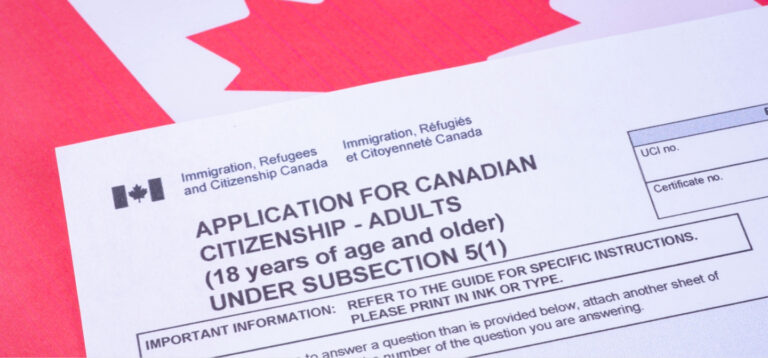
Once you have your documents in order, you are ready to apply for a Canadian citizenship certificate, the official document issued by IRCC that confirms your status as a Canadian citizen.
What the Citizenship Certificate Gets You
The citizenship certificate is your official proof of Canadian citizenship. With it, you can:
- Apply for a Canadian passport
- Access federal benefits as a Canadian citizen
- Exercise voting rights in Canadian elections
- Pass citizenship to your children (subject to the substantial connection rules for those born abroad after December 15, 2025)
Application Options: Online vs. Paper
Online vs. paper: The online portal works well for straightforward first-generation cases. For multigenerational Bill C-3 claims, a paper application (form CIT 0001) is generally recommended — it allows more flexibility for supporting documents and a cover letter explaining your chain of descent.
Fee: $75 CAD
Processing Times
Officially, around 11 to 15 months, though well-prepared applications move faster. Submit everything correctly on the first attempt — missing documents or untranslated records (anything not in English or French requires a certified translation) will restart the clock.
What Happens After You Apply?
Once IRCC receives your complete application, you will receive an Acknowledgement of Receipt (AOR) and a Unique Client Identifier (UCI). You can track your application status online through your IRCC secure account.
If your application is approved, IRCC will issue your Canadian citizenship certificate. You can request an electronic certificate (e-certificate), which is delivered faster, or a physical certificate mailed to your address in the United States.
With your citizenship certificate in hand, you can apply for a Canadian passport. As of April 1, 2026, IRCC guarantees passport processing within 30 business days. A 10-year adult Canadian passport costs $163.50 CAD; a 5-year passport costs $122.50 CAD.
If IRCC determines you are not a Canadian citizen, you will receive a refusal letter, and they will not refund your application fee.

Written by
Adam Pinsky
Adam Pinsky is a marketing and communications consultant with over a decade of journalistic experience in Canadian immigration. He writes for Canadim, translating complex immigration topics into content that helps readers meaningfully understand their options clearly and practically.