
Sponsor Your Spouse or Partner to Canada
Canada’s Spousal Sponsorship Program allows Canadian citizens and permanent residents to sponsor their spouse or partner for Canadian permanent residence. Family reunification is a core pillar of Canada’s immigration system, and spousal sponsorship applications are processed as a priority category.
If you want to bring your husband, wife, common-law partner, or conjugal partner to Canada, this guide explains your eligibility, processing times, government fees, required documents, and how Canadim can help you succeed.
What is the Spousal Sponsorship Program?
The Spousal Sponsorship Program falls under Canada’s Family Class immigration category and is administered by Immigration, Refugees and Citizenship Canada (IRCC).
It allows eligible sponsors to bring their spouse or partner to Canada as a permanent resident.
Eligible Relationship Categories
Canada recognizes three types of relationships (including same-sex couples):
- Spouse: Legally married to the sponsor
- Common-law partner: Lived together in a marriage-like relationship for at least 12 consecutive months
- Conjugal partner: In a genuine relationship for at least one year, but unable to marry or cohabit due to barriers (religious, cultural, immigration, or political)
Determining the correct category is critical. Submitting under the wrong classification can result in refusal.
Unsure which category your relationship may fall under? Learn more: Difference Between Spouse, Common-Law, and Conjugal Partner.
Inland vs. Outland Spousal Sponsorship
There are two main pathways to sponsor your spouse or partner:
Apply outland if:
- The sponsored person lives outside Canada; or
- They are in Canada temporarily, but may leave during processing
Key Advantage: The right to appeal a refusal
Processing Time: Approximately 15 months
Because Canada recognizes dual intent, your spouse may apply for a Temporary Resident Visa (TRV) or Electronic Travel Authorization (ETA) while waiting — but approval is always discretionary.
Apply inland if:
- The sponsored person is living with you in Canada
- They hold (or previously held) a valid temporary status
Processing Time: Approximately 21 months
Applicants under inland sponsorship should avoid travel outside Canada, as re-entry is not guaranteed.
Work Permit Eligibility
In both the Inland and Outland sponsorship streams, applicants who hold a valid temporary status in Canada may also be eligible to apply for a Spousal Open Work Permit. This open work permit allows candidates to workwhile their permanent residence application is in process.
Immigration Tip 💡
If you are eligible for Inland sponsorship, you are also eligible to apply for Outland sponsorship. In many cases, Outland is strategically preferable as it offers shorter processing times.
Spousal Sponsorship Requirements
To sponsor your spouse or partner, you must:
- Be a Canadian citizen or permanent resident
- Be at least 18 years old
- Live in Canada (unless you are a Canadian citizen living abroad with the intent to return)
- Not receiving social assistance (except disability benefits)
- Not be barred due to serious criminal convictions
- Sign a three-year financial undertaking to support your partner
Unlike other sponsorship programs, there is no minimum income requirement. However, you must demonstrate the ability to meet basic financial needs.
Spousal Sponsorship Processing Times (2026)
Processing times depend on the stream and province of intended residence:
- Outland sponsorship: ~15 months
- Inland sponsorship: ~21 months
- Quebec sponsorship: Up to 35 months
Quebec applicants must also obtain a Certificat de sélection du Québec (CSQ), which adds an additional layer of review.
Processing delays can result from:
- Incomplete applications
- Missing documents
- Criminal or medical inadmissibility
- Additional requests from IRCC
Accurate, up-to-date processing times are available directly on the IRCC website.
Spousal Sponsorship Government Fees
Current federal government fees:
- Sponsorship fee: $85
- Principal applicant processing fee: $545
- Right of permanent residence fee: $575
- Biometrics fee: $85/person
Total: $1,290
Additional fees apply for dependent children ($175 per child). Quebec applicants must also pay provincial processing fees for the CSQ: an additional $335 for the sponsor and $135 per dependent child.
For a complete list of IRCC fees, click here.
You can also refer to our detailed article “Spousal Sponsorship in Quebec” for more information.
Find out if you are eligibleRequired Documents for Spousal Sponsorship
Spousal sponsorship applications require substantial documentation to prove:
- The sponsor’s eligibility
- The applicant’s admissibility
- The genuineness of the relationship
Common Required Documents
- Sponsorship and permanent residence application forms
- Proof of Canadian citizenship or permanent residence
- Identity and civil status documents
- Police certificates (for countries lived in for six+ months since age 18)
- Medical exam results
- Proof of relationship (joint leases, joint bank accounts, insurance documents, photos, travel history, communication records, affidavits from family and friends)
For common-law partners, proof of at least 12 consecutive months of cohabitation is mandatory. Proof of cohabitation can include bills with both your names, leases, or joint bank statements, among other things.
If you are in a conjugal relationship and looking into sponsoring your partner, immigration officers will expect to see the following evidence:
- A written statement explaining why you can’t live together or marry
- Photos to demonstrate a genuine relationship for a period of at least 12 months
- Proof of contact (letters, text messages, social media conversations, etc.)
- Proof of visit, if applicable
- Evidence that your friends and family recognize that the two of you are in a relationship
- Proof of financial support and/or dependency
The final decision regarding your proof of relationship documents will be at the discretion of the visa officer, but the more proof you can provide, the better your chances of being accepted.
Immigration Tip 💡
Get creative when trying to prove your relationship. Find pictures and/or documents that tell the story of your relationship, and then provide letters of explanation to make your case to the visa officer. For more info, read our blog on How to Prove a Genuine Relationship.
At Canadim, we can help you find creative ways to demonstrate your relationship and suggest other forms of evidence that immigration authorities may accept.
Why Are Spousal Sponsorship Applications Refused?
Visa officers may refuse applications for:
- Incomplete documentation
- Failure to meet the sponsor eligibility
- Insufficient proof of a genuine relationship
- Misrepresentation
- Criminal or medical inadmissibility
The best way to ensure your spousal sponsorship application is processed as quickly as possible is to make sure it’s done right the first time. The lawyers and legal professionals at Canadim have successfully helped hundreds of clients with their spousal sponsorship applications.
Read our full article here: 6 Reasons Your Sponsorship Application Could Be Denied
Find out how Canadim can help bring your loved ones to Canada by taking our free family sponsorship assessment form.
The Spousal Sponsorship Process with Canadim
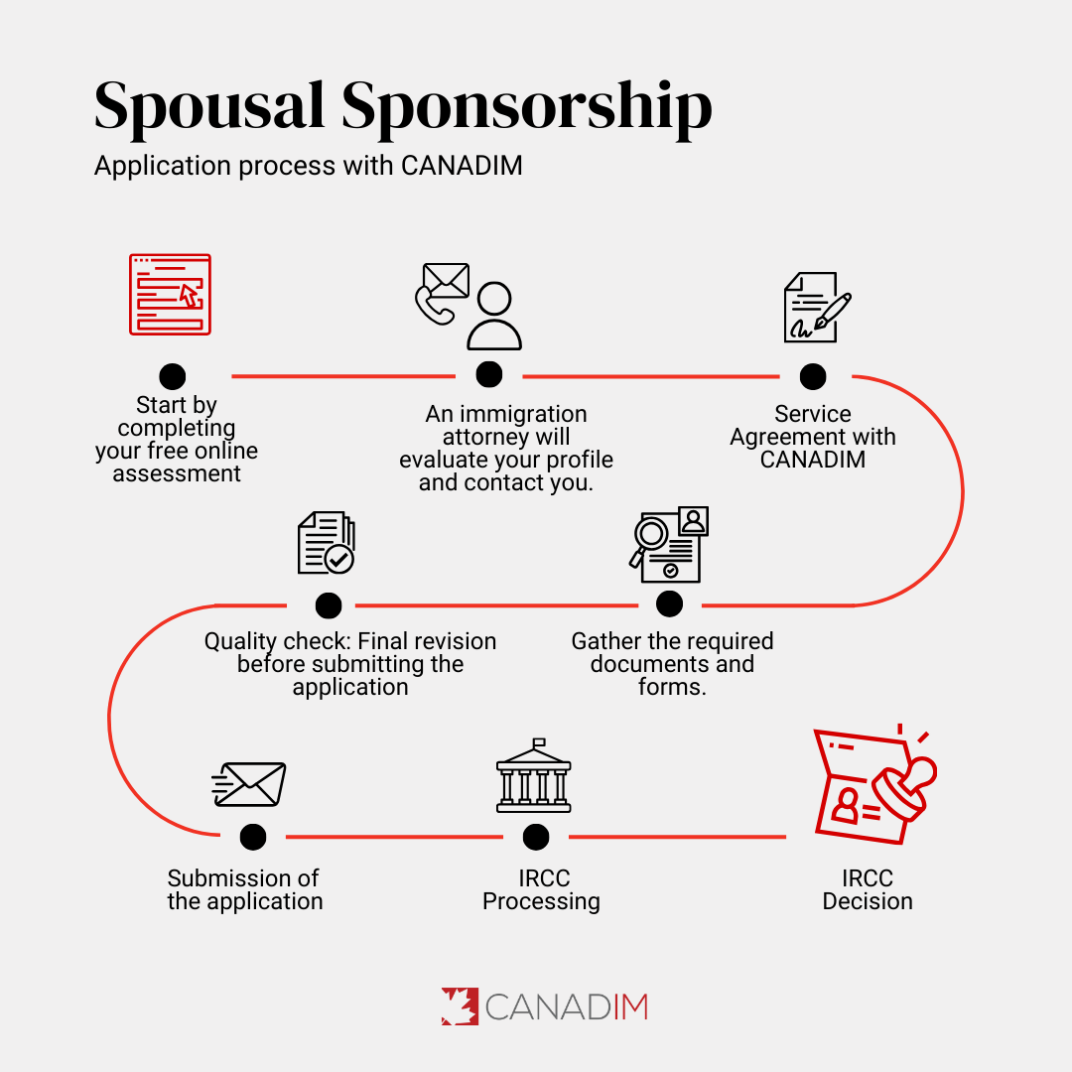
When you work with Canadim, you benefit from our structured legal strategy:
- Complete our free online assessment
- An immigration attorney evaluates your eligibility
- We sign a formal legal retainer agreement
- We prepare and submit your complete application
- We manage all correspondence with IRCC
- We address any procedural fairness letters or additional document requests
While no law firm can guarantee approval, working with experienced immigration lawyers significantly reduces risk and delays.
start my free sponsorship assessmentFrequently Asked Questions (FAQ)
What happens if my spousal sponsorship application is refused?
If your spousal sponsorship application was submitted and refused under the Family Class “outland” category, you have the right to appeal the decision or submit a new sponsorship application.
We recommend consulting with our attorneys to understand the reasons for the refusal and determine the best strategy for submitting a second application to IRCC.
Can I reapply if my spousal sponsorship application is refused?
If the visa officer refuses your spousal sponsorship application, you can reapply. However, it’s crucial to address the reasons for the refusal in your new application. This may involve providing new or additional information or documentation to clarify or correct the issues identified in the refusal.
It’s highly recommended to thoroughly review the refusal letter, obtain the GCMS notes, seek professional advice from a lawyer, and ensure that the new application meets all requirements and addresses any concerns raised by IRCC.
Can I cancel my spousal or partner sponsorship application?
Yes, you can withdraw your sponsorship application at any time before the person you’re sponsoring becomes a permanent resident of Canada.
How do I submit a spousal or common-law sponsorship application?
You submit your spousal sponsorship application through the IRCC Permanent Residence Portal. If you are unable to apply online and require accommodations, such as a disability-related accommodation, you can request the application in an alternative format.
If you hire a law firm, they will submit your application using the Authorized Representative Portal. All correspondence regarding the application will be sent directly to the lawyer, so the client does not need to communicate with IRCC.
Can my spouse or common-law partner include their family members on our spousal sponsorship application?
Yes, your spouse or common-law partner may include any dependent children on their application.
The dependent must be under 22, unmarried, and not in a common-law relationship. In certain circumstances, dependents over 22 years may qualify.
Is an interview required for spousal sponsorship?
It’s unlikely, but possible. Immigration interviews for spousal sponsorship cases are uncommon and generally occur only in specific situations. These interviews are typically triggered when there is a lack of supporting documents for the relationship, discrepancies between the information provided on forms and documents, significant age or religious differences, a short time between meeting your spouse and getting married, or minimal or no cohabitation.
Although the final decision to interview a couple is at the discretion of the visa officer, using the services of a qualified immigration attorney can help to present your application in the best possible light and address any concerns or doubts about the genuineness of your relationship.
My spouse, conjugal partner, or common-law partner has a serious medical condition. Can I still sponsor them?
Likely yes. If your spouse’s medical condition is not a danger to the public health or safety, they will likely not face any issues with their sponsorship application.
There are three kinds of medical inadmissibility: Excessive demand on health or social services, danger to public health and danger to public safety. Medical inadmissibility for excessive demand does not apply to sponsored spouses or common-law partners.
What are my ongoing obligations if I sponsor my partner under the spousal sponsorship?
When sponsoring a spouse, conjugal partner, or common-law partner, you are responsible for fulfilling the basic needs of your partner, including their everyday and health needs, for three years.
You must make sure that your sponsored partner does not require social assistance before signing the undertaking agreement. If your spouse, conjugal partner, or common-law partner does require financial help from the government, you must pay back the full amount they received while you were legally responsible for them.
Your financial obligation will stay in effect even if:
- Your partner becomes a Canadian citizen
- Your relationship ends
- Your partner moves to another country or province
- You experience financial problems
Can my spouse, common-law partner, or conjugal partner come to Canada while waiting for approval?
Yes, if they are granted authorization. Your spouse or partner can apply for a Temporary Resident Visa (TRV) or an Electronic Travel Authorization (ETA) if they are from a visa-exempt country, allowing them to come to Canada while the spousal sponsorship application is in process.
Applicants applying for a Temporary Resident Visa (TRV) must satisfy the visa officer assigned to their case that they will leave at the end of the visa’s validity. Having an application for permanent residence can raise a visa officer’s doubt that the applicant intends to leave at the end of their visa.
Can I sponsor my partner if I’m unemployed?
Yes, you do not need a job to sponsor your partner to come to Canada. Unlike other sponsorship programs, there is no minimum income requirement for spousal sponsorship.
However, since you are required to sign an undertaking agreement promising to support your partner’s basic needs, the immigration officer may assess whether you have sufficient funds to sponsor them. As such, you should provide documentary evidence showing how you plan to support your partner in Canada.
Does my partner need a job offer to be sponsored under the spousal sponsorship program?
No.
How much money do you need to sponsor your spouse, conjugal partner, or common-law partner to Canada?
You do not need to demonstrate a minimum income to sponsor a partner. However, whenever you sponsor a family member to Canada, you must sign an undertaking in which you promise to provide financial support for the basic needs of your sponsored family member.
The undertaking lasts three years from the day the sponsored individual becomes a Canadian permanent resident.
Can I leave Canada while my spousal sponsorship application is in process?
Yes, but it’s risky. Since residing in Canada is a requirement for inland sponsorship, leaving the country could jeopardize your application if you are not permitted to re-enter. A Canadian Border Services Agency (CBSA) officer has the discretionary power to allow or deny entry to a foreign national.
Having a permanent residence application in process or holding a Temporary Resident Visa (TRV) or an Electronic Travel Authorization (ETA) does not guarantee entry into Canada. The border officer makes the final decision at the port of entry.
Another consideration is whether the sponsored spouse has applied for an open work permit and is currently on maintained status in Canada. In this case, they should not leave Canada and wait for their work permit application to be approved.
If you are a Canadian permanent resident sponsoring your spouse, you must be and remain in Canada during the processing of a spousal sponsorship application.
Does my partner need to demonstrate proficiency in English or French?
No, your sponsored spouse, conjugal partner, or common-law partner is not required to demonstrate their proficiency in English or French.
Is there a limit to the number of spousal sponsorship applications accepted by Canada?
Yes, there is an annual immigration quota that Canada must respect. For 2026, this number is 69,000; for 2027 and 2028, it is 66,000 per year.
It is important to note that if you are considering settling in the province of Quebec, there is a quota on the number of CSQs issued between June 2024 and June 2026. You can read more about this here.
Do I get permanent residence if I marry a Canadian citizen?
No. Marrying a Canadian does not automatically grant the spouse Canadian permanent residence. Once you are married, you can apply for spousal sponsorship.
The spouse will become a Canadian permanent resident only after the spousal sponsorship application is approved.
Can I sponsor my conjugal or common-law partner if I am legally married to someone else?
Yes, in some circumstances, but you will need to provide additional documentation. If you wish to sponsor your common-law partner but are legally married to another person, you must provide proof that your marriage has broken down and that you have lived apart from your spouse for at least one year.
You can only count time physically separated from your spouse toward time cohabitating with the common-law partner you wish to sponsor. To demonstrate the end of your spousal relationship, you should provide additional documentation, such as:
- A formal declaration regarding the end of the marriage and the beginning of a common-law relationship
- An official separation agreement
- A court order in respect to the custody of children (if applicable)
- Documents showing the removal of the legally married spouse from insurance policies or wills
Can I sponsor my common-law partner if we are not currently living together?
Yes, provided you meet certain conditions. A common-law couple living separately due to extenuating circumstances, such as a family emergency, hostile country conditions, or employment or education-related reasons, may still be eligible for sponsorship.
To sponsor your common-law partner, you must have been living or have lived with your partner for at least 12 consecutive months in a marriage-like relationship. If you are not currently living with your partner at the time of applying, you must provide sufficient evidence that you have previously lived together and intend to live together in Canada upon being sponsored. You will also need to provide convincing evidence to show that while living apart, you have continued to maintain your common-law relationship.
Can I sponsor my same-sex spouse or partner?
Yes. Canada recognizes same-sex marriages and relationships, and you can submit a sponsorship application as long as you meet the eligibility criteria. Please note that for immigration Canada to recognize a foreign marriage, the country where it took place must also recognize it.
How long do you have to be married to sponsor a spouse in Canada?
There is no required length of time you must have been married before submitting the application. As soon as you have obtained the marriage certificate and meet the eligibility requirements, you can submit the application.
Can you sponsor a spouse or common-law partner if you are living outside Canada?
Yes, if you are a Canadian citizen. A citizen living abroad can sponsor a spouse or common-law partner, provided they can demonstrate an intent to reside in Canada once their sponsored relative becomes a permanent resident.
A permanent resident of Canada residing abroad is not eligible to sponsor a family member.
Can I use a cohabitation letter as proof for common-law sponsorship?
Yes, but additional documentation will likely be required. There is a specific list of documents that you must submit to IRCC to prove your common-law relationship. Our immigration attorneys can provide guidance on the necessary documents and any additional evidence that may strengthen your application.
What happens if I don’t have all the required documents for sponsorship?
If you can’t provide all the documents outlined above, our lawyers can help you find creative ways to demonstrate your relationship, suggesting other forms of evidence that immigration authorities may accept.
What happens after I submit the spousal sponsorship application?
After you submit the sponsorship application, an officer will review it to ensure that it is complete (including signed forms and translated documents). If everything is in order, IRCC will issue an Acknowledgement of Receipt (AOR).
Once the sponsor’s eligibility is confirmed, an Approval of Sponsor letter is issued, typically considered the first stage of sponsorship approval.
The second stage begins when the principal applicant meets the eligibility requirements, and an Approval in Principle is issued. However, criminal and medical checks still need to be completed at this stage.
Do I need a lawyer to apply for spousal sponsorship?
No, you do not need to retain a lawyer to apply for spousal sponsorship. However, there are key benefits of working with a lawyer for your case, including: expert guidance, increased chances of success, time and stress savings, personalized attention and peace of mind.
What happens if I have a child with my partner during the sponsorship process?
You must contact the IRCC of any change in circumstances, such as:
- Birth or adoption of children
- Marriage, divorce, or separation
- Death of an applicant or dependent
Can I sponsor my spouse or common-law partner if I have a criminal record?
It depends on the seriousness of the criminality. If your conviction is for an offence of a sexual or violent nature, you may not be eligible to sponsor. A full list of offences that could lead to a sponsorship bar is available on the IRCC website here.
What happens after my spousal sponsorship is approved?
Once the spousal sponsorship application is approved, IRCC will send instructions on how to finalize your permanent residence process. This may include steps to confirm your permanent resident status and obtain your permanent resident card.
Can I sponsor my partner if we are not married but in a relationship?
You do not need to be married to sponsor your partner. If you have documentary evidence to prove a common-law or conjugal relationship, you can submit a sponsorship application.
However, simply being in a relationship or engaged without meeting the other eligibility requirements is not sufficient. You must demonstrate that your relationship is genuine and meet other criteria set by IRCC.
Is spousal sponsorship different in Quebec?
Yes. When planning to sponsor your spouse to join you in Quebec, it’s crucial to note that the sponsorship process differs from the rest of the country.
We invite you to explore our page on Quebec spousal sponsorship, which provides valuable insights to help you be well-prepared and informed for a seamless sponsorship process.
Ready to start?
Sponsor your spouse to Canada with confidence!
Spousal sponsorship may appear straightforward, but even minor errors can lead to delays or refusals. Every relationship is unique, and immigration officers carefully assess each case.
At Canadim, our immigration lawyers prepare comprehensive, legally sound applications designed to meet IRCC standards and minimize risk.
Free sponsorship assessmentRelated Links
Discover your Canadian immigration options. Get your free assessment now!